One of the practical challenges we encountered while developing the Sloyd Workshop was surprisingly simple:
How do you hold very thin wood firmly enough for a child to saw it by hand without the wood moving, vibrating or breaking?
The workshop uses wood as thin as 5 mm. With thin material, an ordinary vice can leave too much of the wood unsupported. As the saw moves through it, the wood can flex, vibrate or snap.
There is also a safety consequence. If the wood moves, a child’s natural instinct is to use the other hand to steady it — bringing that hand closer to the saw.
So the problem was not simply how to tell children to keep their hands away from the blade.
The equipment needed to make that second hand unnecessary.
Developing the vice
The original vice worked well for many of the small pieces we were using, but testing showed that larger pieces of 5 mm wood were not stable enough when sawn by hand.
We found a solution through practical testing.
The result is that even very thin wood can be held firmly enough for a child to saw without needing to steady it with the other hand.
The saw matters too
The saw was another part of the system.
After testing different options, we found a solution that made thin wood easier for children to cut and control.
Testing with children
Our system was first tested practically with groups of Class 4 children.
At that stage we were still using the original vice. The system worked extremely well.
Each child measured and marked a 5 × 5 cm square, cut it by hand and sanded the finished piece.
The children were able to concentrate on measuring, controlling the saw and finishing their own work rather than struggling to hold the material still.
The practical session also showed us where the system could be improved before moving on to larger or more demanding pieces.
That led to the vice prototype.
Prototype testing
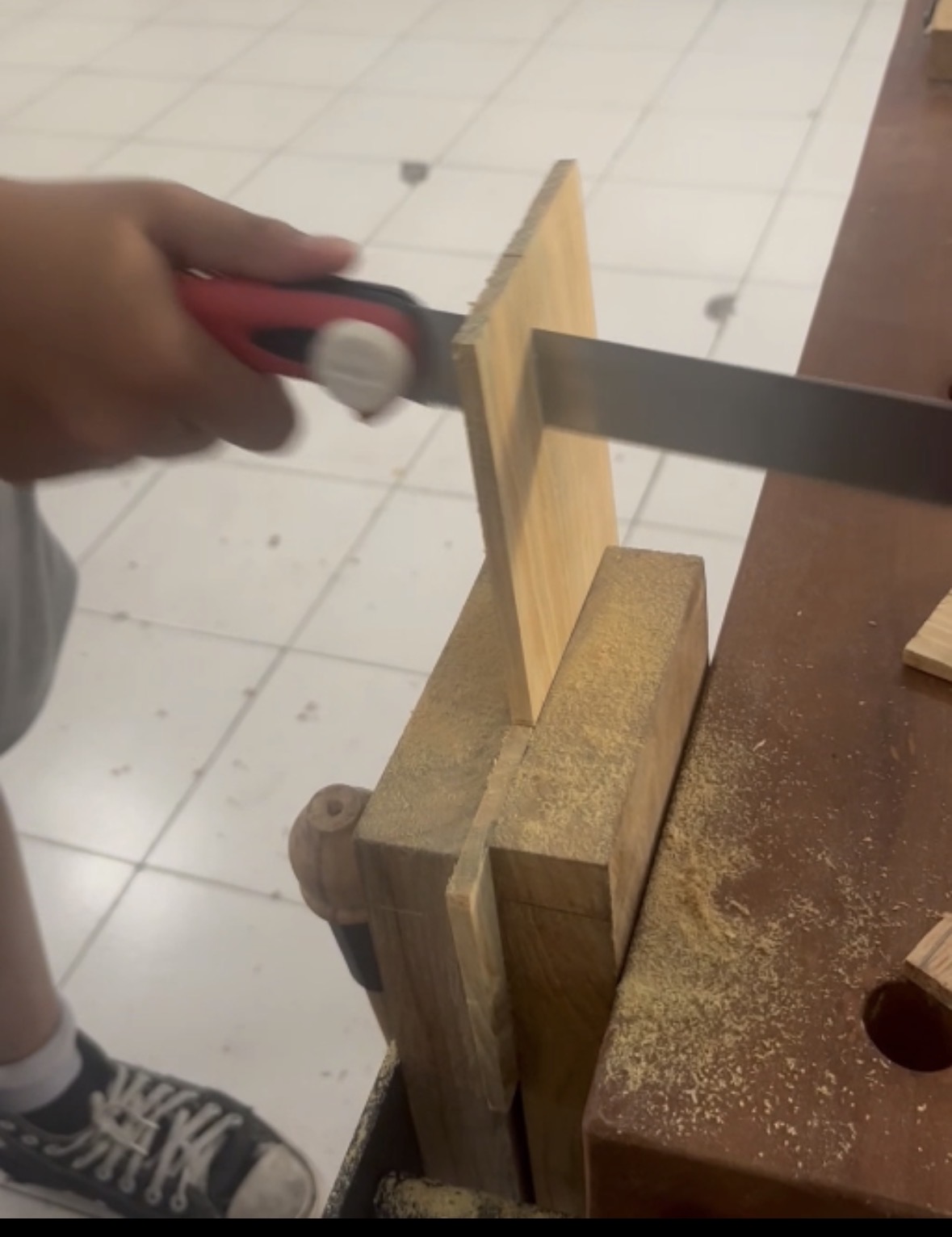
Designing safety into the equipment
This reflects an important principle behind the workshop:
wherever possible, safety should be built into the equipment and the working method rather than depending entirely on repeatedly telling children what not to do.
Children still need instruction and supervision, of course. But good equipment can remove some hazards before the child has to think about them.
Developed for the Sloyd Workshop
The workbench and vice system were developed and tested specifically for the Sloyd Workshop pilot at SD Kristen Widya Wacana Jamsaren, Surakarta.
As the mother of a student at the school, I was asked by the head teacher to help develop the workshop because of my previous business experience. I went on to lead its technical development, with the vice system refined through repeated practical testing with teachers and students.
The aim was straightforward: to make thin wood stable enough for young children to cut safely, successfully and independently by hand.
Working together, we achieved that aim.